



KEY TAKEAWAYS
AI is embedded in financial services workflows — from customer experiences to fraud detection and back-office automation — and even inside vendor products your teams already rely on.
The opportunities are significant, but so are the challenges: bias, opacity, privacy leakage, adversarial attacks, concentration risk in third-party AI models, and unexpected outputs. The path forward is to treat AI like any other high‑impact enterprise technology. Govern it, inventory it, measure it, and manage it continuously.

How AI Risk Frameworks Work Together
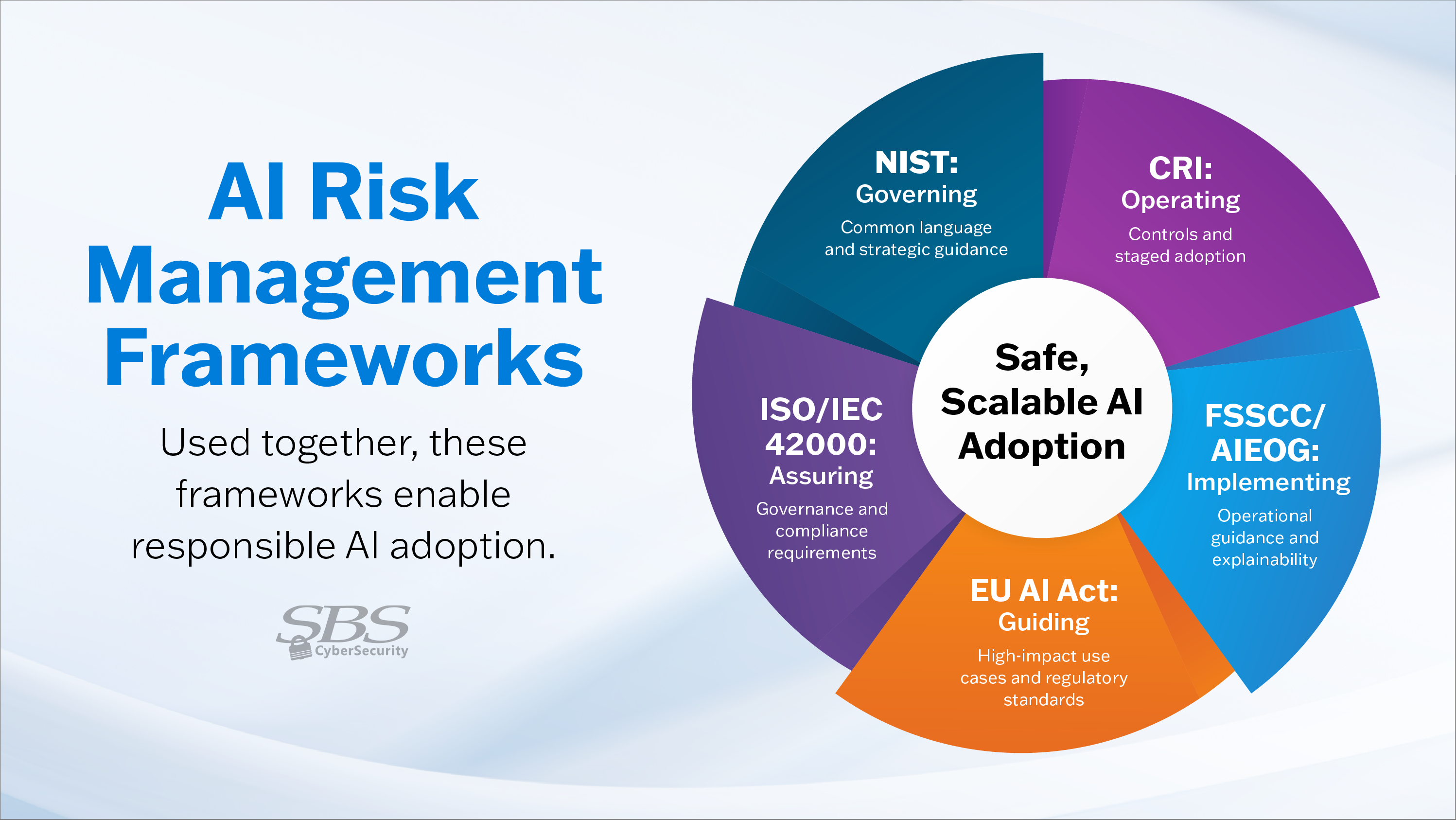
Each framework plays a distinct role. Used together, they provide structure, operational guidance, regulatory perspective, and practical implementation support. Collectively, these risk management frameworks outline how institutions identify, assess, and manage AI risk from initial use through ongoing operation.
The NIST AI RMF: The North Star
The NIST AI Risk Management Framework (AI RMF 1.0) provides a voluntary, cross-industry structure for managing AI risk and building trustworthy AI systems. Flexible and nonprescriptive, it can be applied across use cases and maturity levels.
The AI RMF Core is organized into four functions:
- Govern: Embedded across all activities, guiding policies and oversight
- Map: Understand context, intended use, impacts, and dependencies
- Measure: Test, evaluate, validate, and monitor AI systems
- Manage: Prioritize, respond, and sustain risk treatment over time
Think of NIST as the alignment tool: common language, structured approach, and a clear reminder that governance should influence what you build, buy, and operate.
Many financial institutions struggle because NIST intentionally avoids turning itself into a checklist. That's a strength, but it also means teams need a bridge from principles to practical controls and evidence.
The CRI Financial Services AI RMF: The Map
If NIST is the North Star, the Cyber Risk Institute's Financial Services AI Risk Management Framework (FS AI RMF) is the map — the operational playbook for financial institutions. It translates NIST principles into a structured approach that complements existing risk management programs.
1. It Operationalizes NIST into Control Objectives
CRI maps NIST's four functions into 230 control objectives, moving the conversation from alignment to implementation, monitoring, and reporting.
2. It Scales Adoption with Maturity Stages
The AI Adoption Stage Questionnaire classifies organizations into four stages:
- Initial: Limited, protective use cases
- Minimal: Low-risk implementations
- Evolving: Higher-risk production applications
- Embedded: Enterprise-wide integration, including autonomous decision-making
Controls scale by stage, preventing the common mistake of "AI for everyone" before governance, oversight, and monitoring are ready.
3. It Integrates with Existing Programs
CRI aligns naturally with enterprise cybersecurity, risk, and compliance programs, enabling integrated assessments, prioritization, and mitigation. AI is treated as an enterprise risk, not a standalone initiative.
Supporting Guidance from FSSCC and AIEOG: The Compass
A North Star and a map provide direction, but institutions also need tools to stay oriented and interpret what they're seeing.
To support the implementation of the FS AI RMF, the FSSCC and AIEOG released guidance to help financial institutions operationalize, evidence, and defend AI governance in practice. These resources extend the framework into specific, high‑impact risk areas, including:
- AI lexicon: Establishes a shared vocabulary across governance, risk, compliance, and regulatory conversations
- Explainability guidance: Addresses transparency challenges in AI and generative AI
- Data nutrition labels: Standardizes documentation of data provenance, quality, and limitations
- AI‑driven threats and fraud: Covers identity attacks (including deepfakes and impersonation), fraud trends, and mitigation considerations
The EU AI Act: The Weather
The EU Artificial Intelligence Act establishes legally binding, risk‑based rules for AI in the European Union. Even if your institution isn't directly subject to the Act, it offers a benchmark for global expectations — particularly for high-impact AI and vendor ecosystems.
Think of it as the weather: You may not "live" in the system, but you will likely feel it through vendors, market expectations, and evolving regulatory scrutiny.
The EU AI Act reaches a significant enforcement milestone in August 2026, requiring organizations using high-risk AI to demonstrate documented governance, risk controls, transparency, and human oversight, with real penalties for noncompliance.
ISO/IEC 42001 and the 42000 Series: The Wind
The ISO/IEC 42000 series establishes a global baseline for how organizations govern, assess, and assure AI systems.
ISO/IEC 42001, released in December 2023, defines requirements for AI management systems across the lifecycle, including accountability, risk management, monitoring, and continuous improvement. Supporting standards extend this foundation with guidance on AI impact assessments and independent assurance.
In the context of AI risk governance, the ISO/IEC 42000 series serves as the prevailing wind rather than a destination. Most community and regional financial institutions will not pursue ISO certification, but the direction these standards set matters. They reflect the evolving global expectations for AI governance, documentation, assurance, and accountability.
Building AI Governance into Cybersecurity and GRC
AI risk touches multiple domains, including cybersecurity and governance, risk, and compliance (GRC):
- Cybersecurity: New attack surfaces, misuse, and data exposure
- Vendor risk: Model opacity, training data provenance, and concentration risk
- Privacy: Handling sensitive data across the AI lifecycle
- Operational resilience: Monitoring, incident response, and change management
NIST emphasizes that risk can vary across the AI lifecycle and that third-party data or software can complicate responsibility. CRI addresses these realities with objectives spanning inventory, governance, monitoring, incident integration, and vendor evaluation.
The takeaway: AI governance isn't about restricting innovation. It enables safe, responsible adoption with visibility and accountability.
Start Small and Scale AI Safely
Many institutions adopt a phased approach — often called "crawl, walk, run" — to introduce AI in manageable steps while building governance and oversight. AI adoption should begin with measurable use cases and grow in a structured way, balancing innovation with control.
Foundations: Build an AI Inventory and Governance Committee
Before starting use cases, establish the governance and inventory foundations:
AI Inventory
- Track the purpose and intended use of each AI system
- Document data sources, responsible personnel, and dependencies
- Record risk ratings, compliance requirements, and lifecycle considerations
- Include AI used in purchased products and shadow systems
AI Governance Committee
- Define roles, oversight, policies, training, escalation, and leadership visibility
- Key questions to clarify:
- Who approves AI use cases?
- Who owns risk acceptance?
- What controls are mandatory before deployment?
- What metrics must be monitored?
- How are incidents handled and escalated?
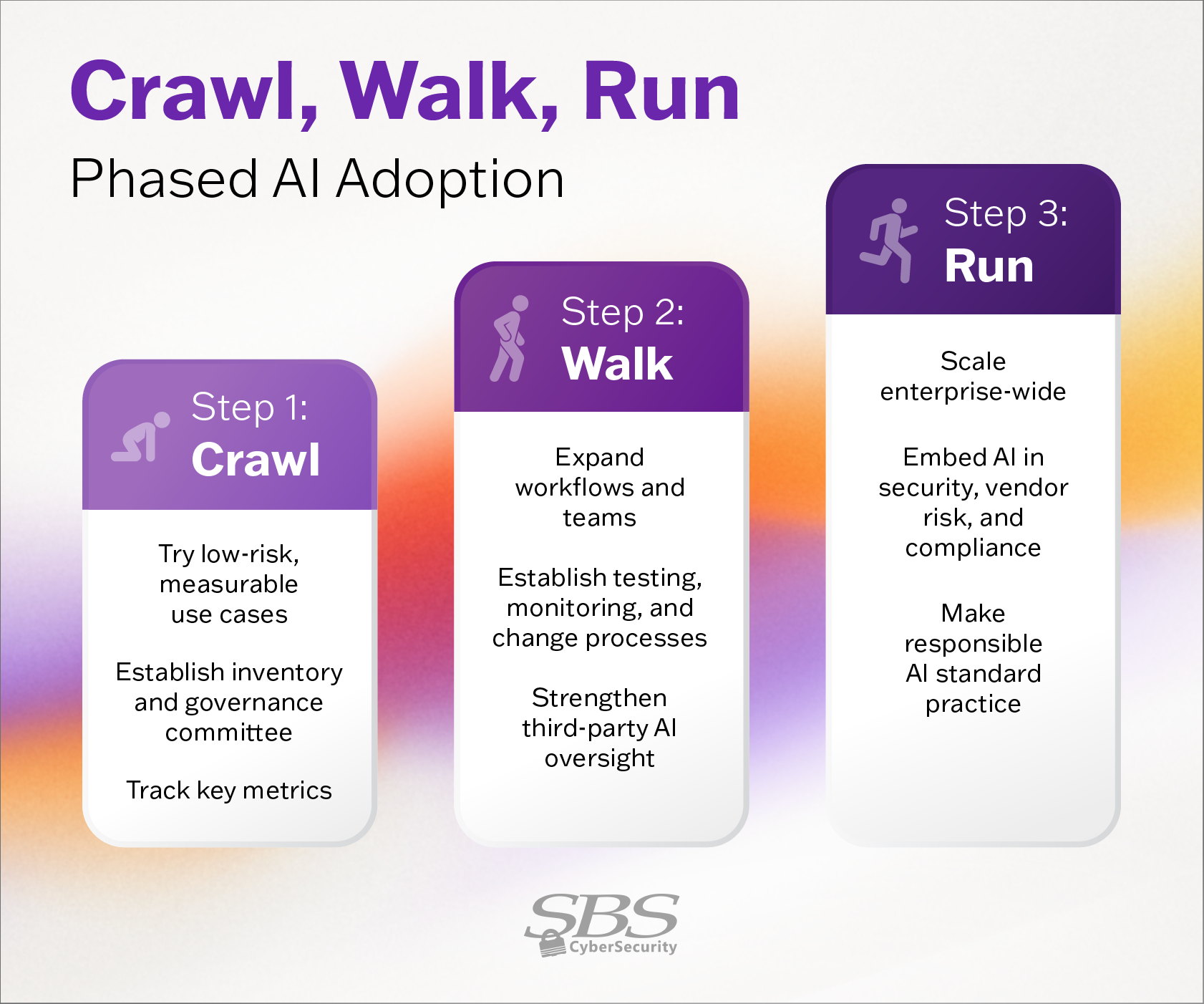
Crawl: Start with 1–2 Measurable Use Cases
Now that foundational governance is in place, focus on low-to-moderate risk applications that are bounded and easier to govern.
Use Case #1: Internal Knowledge Assistant
- What it is: A restricted AI tool that answers employee questions using approved internal content
- Why it's a good crawl candidate: Internal-facing, controlled content, and measurable performance
- Governance actions: Define intended use, test outputs, and establish incident response paths
Use Case #2: Document Summarization
- What it is: AI-assisted summaries of controlled workflows with human review
- Why it's a good crawl candidate: High ROI, low exposure, and built-in oversight
- Governance actions: Enforce data handling rules, require review, and track key metrics
Walk: Expand and Integrate
Once crawl use cases are stable and measurable:
- Expand into workflows and teams
- Establish testing, monitoring, and change management for models and prompts
- Strengthen third-party AI oversight
- Keep adoption evidence-driven, not hype-driven
Run: Scale with Confidence
Broader adoption occurs when governance, monitoring, and leadership oversight are mature:
- Scale enterprise-wide
- Embed AI in security, vendor risk, and compliance processes
- Make responsible AI standard practice

Enable Safe, Scalable AI with Integrated Frameworks
When used together, these frameworks provide a clear path to safe, scalable AI adoption.
- NIST: Strategic foundation and common language
- CRI: Operational playbook and staged controls
- FSSCC/AIEOG guidance: Implementation and explainability support
- EU AI Act: Benchmark for high-impact use cases and regulatory expectations
- ISO/IEC 42000 series: Global direction for governance and assurance
Together, these frameworks make AI governance an enabler. Institutions can confidently approve use cases, demonstrate oversight to leadership and regulators, and scale adoption without exposing themselves to unmanaged risk.

Operationalize AI Risk Management

Gain a clear AI strategy with governance, risk management, vendor validation, and pilot projects designed to deliver measurable outcomes.
Read More
Master AI in banking through strategy, governance, risk management, and vendor evaluation, using practical tools to move from exploration to execution.
Read More