



KEY TAKEAWAYS
AI is moving from isolated experiments to structured workflows that must deliver reliable and trustworthy results, especially in regulated industries. Developers sit at the center of that shift. With structured prompting and the right guardrails, hours of manual reviews and documentation can become automated, governed workflows that cybersecurity and compliance teams trust.
Cyber teams continue to face rising pressure, particularly in sectors where documentation, alerts, and audits consume significant time. Banks must demonstrate Gramm-Leach-Bliley Act (GLBA) compliance, healthcare organizations must maintain HIPAA documentation, and critical infrastructure companies must respond to mounting regulatory scrutiny. Stress levels are also climbing — 66% of cybersecurity professionals report that their role is more stressful than it was five years ago (ISACA).
This is where developers can make a meaningful impact. Through smart AI integration and structured prompting, you can streamline work for cyber teams and transform tasks that once took hours into minutes of consistent, auditable analysis. Beyond generating creative responses, prompting also strengthens core business workflows and compliance practices.
What Is Prompt Engineering, and Why Should Cyber Teams Care?
Prompt engineering is the practice of crafting structured inputs that produce consistent, useful outputs from large language models (LLMs). It parallels writing precise function signatures, but instead of defining parameters for code, you define parameters for how AI reasons.
Unlike casual AI queries, structured prompting uses repeatable patterns. You establish role, context, task, and output format up front, then refine as needed. This systematic approach turns AI from a creative tool into a dependable component of business processes.
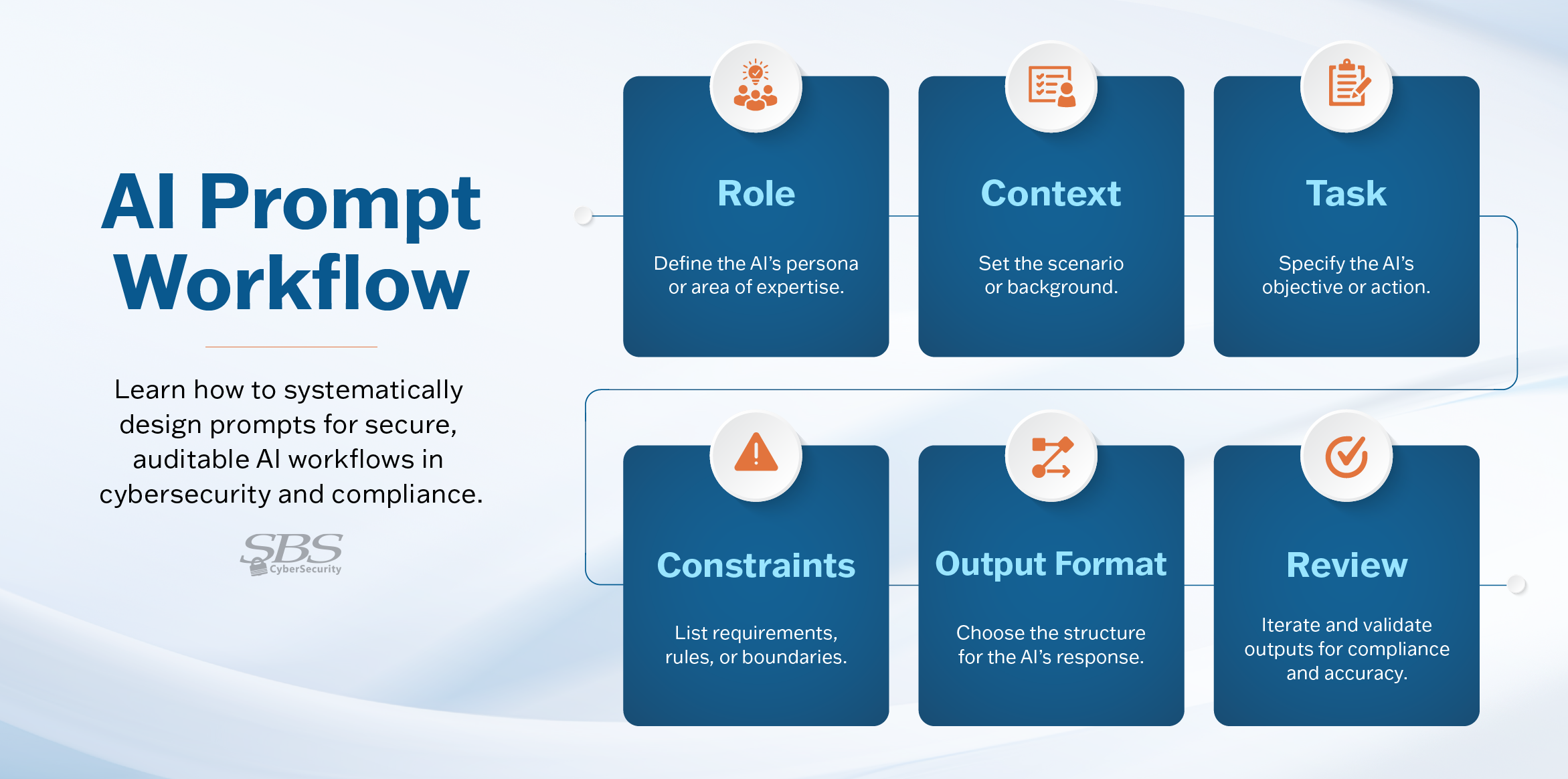
For regulated environments, this reliability is essential. Outputs must be accurate, explainable, and auditable. Strong prompting supports those outcomes with predictable structure, clear audit trails, and consistent formatting. NIST's July 2024 updates to its AI Risk Management Framework reinforce the need for structured approaches to AI governance and risk management.
Where Prompting Can Help: High-Impact Use Cases for Cyber Teams
The most effective prompting solutions address key pain points in cybersecurity workflows. They reduce manual effort while improving consistency and auditability, both essential in regulated environments. These solutions help organizations like banks leverage AI for risk management while maintaining regulatory compliance.
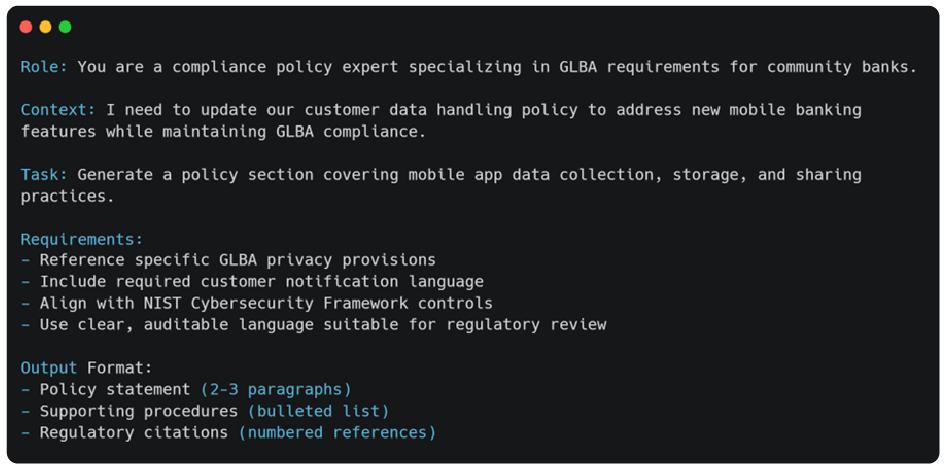
Policy Generation and Review
The Challenge
Updating policies is time-consuming. A single GLBA privacy policy update may require reviewing numerous regulatory requirements, cross-referencing existing controls, and ensuring consistent language across documents.
The Solution
Prompt-driven tools can generate first drafts aligned with regulatory frameworks, saving hours of work while maintaining consistency with established controls and standards.
Sample Prompt Pattern
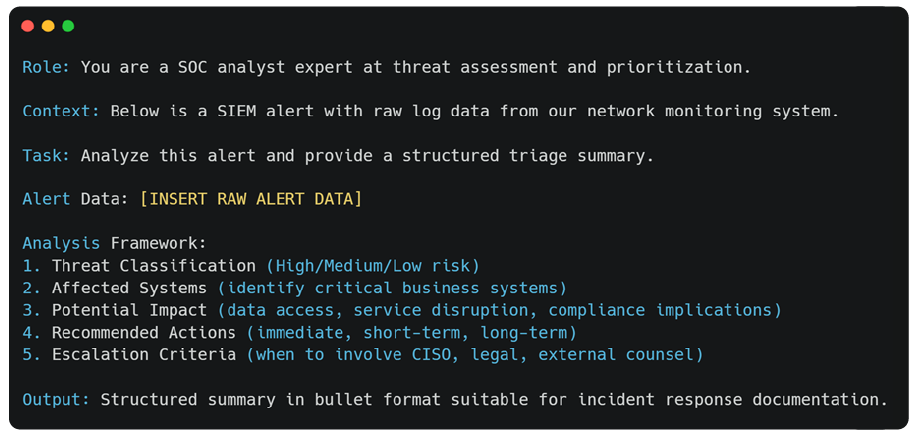
Alert Summarization and Triage Support
The Challenge
SOC analysts often face alert fatigue, as they review hundreds of alerts daily. Parsing raw log data and assessing threat severity takes significant time and can delay responses.
The Solution
Prompts can turn raw alert data into actionable summaries, streamlining triage and helping analysts prioritize threats efficiently without compromising accuracy.
Sample Prompt Pattern
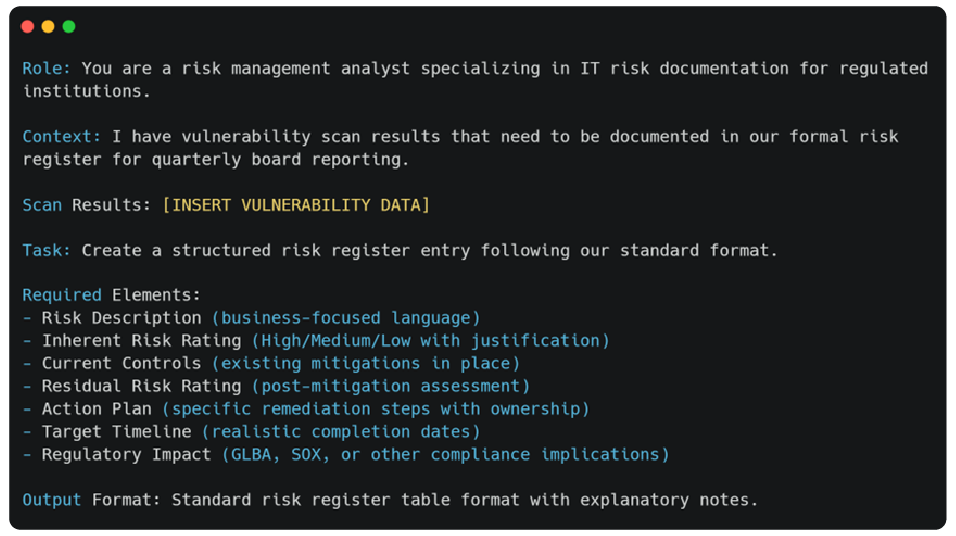
Documentation and Risk Registers
The Challenge
Translating scan results, audit findings, or assessments into compliance documentation is a labor-intensive process. Risk entries require consistent formatting, accurate ratings, clear remediation timelines, and full auditor traceability. Although some organizations are testing AI-enabled tooling, most still depend on manual processes that make consistency and accuracy difficult to maintain at scale.
The Solution
Prompt workflows can draft risk register entries, vendor summaries, and control justifications, boosting consistency and traceability for audits and board reporting.
Sample Prompt Pattern
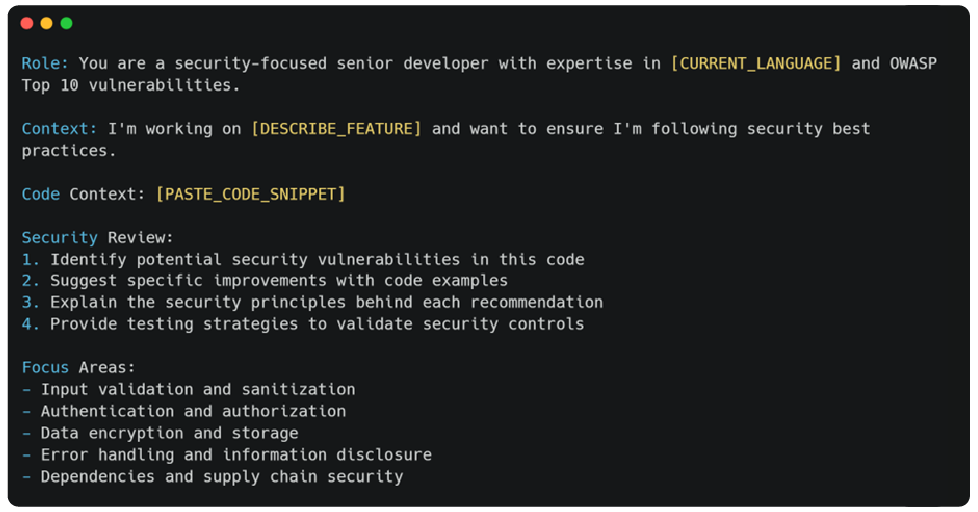
Developer Security Coaching
The Challenge
Developers need practical, context-aware security guidance. Traditional training often feels disconnected from daily coding, making real-time application difficult.
The Solution
Tools like Copilot can provide secure coding recommendations tailored to actual code and tech stack, reinforcing security best practices within existing workflows.
Sample Prompt Pattern
Tooling Overview: What Developers Can Use to Build Prompt-Based Solutions
You don't need to wait for fully productized platforms. Several off-the-shelf APIs and services already support the development of responsible AI workflows.
Enterprise-Ready Options
Azure OpenAI and Google Gemini
- Best for: Deployments requiring data residency and strong compliance controls
- Pros: Enterprise-grade security and integration with existing controls
- Cons: More complex setup and vendor lock-in potential
OpenAI API and Assistants API
- Best for: Custom internal tools and workflows
- Pros: Robust features, function calling, and flexible customization
- Cons: Data leaves the environment, usage costs, and necessity of careful guardrails
GitHub Copilot
- Best for: In-editor guidance and secure coding support
- Pros: Integrated into developer workflows
- Cons: Limited customization and subscription requirement
LangChain and LlamaIndex
- Best for: Context-aware internal tools with complex reasoning needs
- Pros: Connects LLMs to internal data and documentation
- Cons: Higher complexity and infrastructure requirements

Security and Governance Considerations: Prompting Isn't Risk-Free
Implementing AI workflows in regulated environments requires careful attention to security, compliance, and data governance. Key areas to address include prompt injection, output validation, data privacy, and access controls.
Prompt Injection
Attackers can embed hidden instructions in inputs that cause AI to ignore constraints or generate incorrect content.
Mitigation Strategies
- Validate and sanitize all inputs before sending them to the AI.
- Review and validate outputs for format and content.
- Clearly separate system prompts from user input using delimiters.
- Regularly test workflows with adversarial inputs.
Output Validation
AI-generated outputs can be inconsistent or inaccurate, especially when referencing regulatory requirements.
Recommended Approach
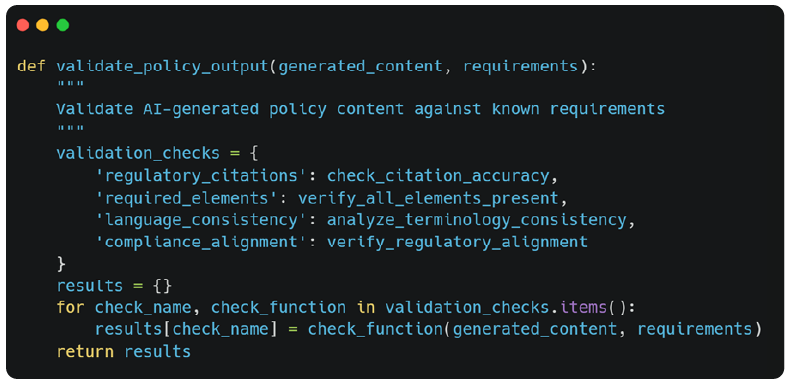
- Define expected output formats and enforce structured responses. For example, a validation function can check AI-generated policy content against known requirements.
- Apply human review for compliance-critical content to ensure accuracy, even after automated checks.
Sample Prompt Pattern
Data Sensitivity and Privacy
Confidential data should never be sent to public LLMs without anonymization.
Best Practices
- Use synthetic or anonymized data for prompts.
- Apply data classification policies to AI workflows.
- Consider private cloud or on-premises LLMs for sensitive use cases.
- Maintain detailed audit logs of AI interactions.
Access Controls and Governance
Limit who can run prompts and access outputs, particularly when workflows involve compliance-critical information.
Recommended Controls
- Implement role-based access for different prompt categories.
- Establish approval workflows for high-risk AI outputs.
- Log all AI interactions comprehensively.
- Conduct regular access and permission reviews.
Why Prompting Is a Strategic Advantage in Regulated Industries
Prompting improves clarity, consistency, and defensibility across cybersecurity operations. Faster policy updates support regulatory responsiveness. Automated triage speeds up threat response. Consistent documentation strengthens audit readiness. These outcomes create meaningful competitive advantages.
As cybercrime costs are projected to reach $12.2 trillion annually by 2031 (Cybersecurity Ventures), organizations building secure AI workflows now will be better positioned for emerging regulations and scrutiny.

Smarter AI Adoption Starts with Collaboration
The strongest results happen when developers and cybersecurity teams collaborate from the start. Developers contribute system design and workflow expertise, while cyber teams bring regulatory knowledge. Both are essential for designing prompts that reflect real-world risk and operational needs.
By working together, teams can build secure, auditable AI workflows that reduce manual burden, improve documentation quality, streamline alert triage, and maintain policy consistency. Starting with low-risk use cases, establishing guardrails early, and integrating human validation ensures that AI tools remain reliable and compliant. Organizations that master this collaborative approach are better positioned to respond to regulatory changes, mitigate risk, and create a strategic advantage with AI-powered cybersecurity operations.

Guided AI Adoption for Cyber Teams

Gain a clear AI strategy with governance, risk management, vendor validation, and pilot projects designed to deliver measurable outcomes.
Read More
Master AI in banking through strategy, governance, risk management, and vendor evaluation, using practical tools to move from exploration to execution.
Read More